
Which career path will still matter when automation reshapes the market? This guide answers that question with a clear, practical list for the United States.
It will explain how roles were chosen: projected growth, talent shortages, and real-world hiring pressure in tech, health, and infrastructure. Readers will get concise information on what each job does, the key skills to build, training routes, and why employers value the role.
Use this guide to map a career path. It covers degree-based tracks like data science and healthcare leadership, plus faster entry options such as skilled trades and logistics.
The goal is action: pick a direction, then match skills, training time, and next steps. Salary, security, and regional variation are noted so readers can make realistic choices and spot genuine opportunities for growth.
What “High-Demand” Means in the US Job Market
This section explains the practical signals that show a career will stay valuable through 2026.
How projected growth and talent shortages create opportunities
Projected growth measures long-term expansion, while short hiring spikes reflect temporary needs. When growth outpaces the supply of trained workers, companies post more openings than they can fill.
Why strong demand often brings higher pay and security
When firms compete for scarce skills, salary ranges and total compensation tend to rise. That competition can also lower layoff risk and speed advancement for qualified candidates.
“BLS projections show roles like nurse practitioners and data scientists growing far faster than average, driving both openings and higher pay.”
Fastest-growing industries shaping work in 2026
Technology, healthcare, renewable energy, logistics, and infrastructure modernization are leading growth. These industries create persistent gaps because training pipelines and regulation change faster than worker supply.
| Indicator | Meaning | Impact on pay | Typical example |
|---|---|---|---|
| Projected growth | Long-term increase in openings | Often raises salary | Data scientist (36%) |
| Talent shortage | More openings than qualified workers | Significant salary competition | Information security analyst (33%) |
| Replacement need | Turnover or retirements | Stable demand, steady salaries | Medical services managers (29%) |
- Confirm demand signals with labor data and company postings.
- Compare training time and education requirements.
- Assess long-term mobility and business fit.
Next: the guide moves into specific careers, starting with technology and analytics.
Top High Demand Job Roles for 2026 in the United States
The next list highlights tech professions that combine pay, projected growth, and employer need.
Data scientist
What they do: frame business questions, clean data, build models with Python and SQL, and translate results for stakeholders.
Snapshot: median salary $112,590; projected growth 36%; typical requirement: bachelor’s degree.
Information security analyst
What they do: monitor threats, write policies, run compliance checks, and coordinate teams to reduce risk.
Snapshot: median salary $124,910; projected growth 33%; typical requirement: bachelor’s plus 3–5 years experience.
Software developer
What they do: build features, test, fix issues, and ship user-ready software that meets performance and usability goals.
Snapshot: median salary $130,450; projected growth 17%; typical requirement: bachelor’s degree.
Web developer
Tracks include front-end, back-end, full-stack, and webmaster. Companies pick skills based on product needs and scale.
Snapshot: median salary $95,380; projected growth 8%; typical requirement: bachelor’s degree.
IT manager
What they do: align technology roadmaps to business goals, manage services continuity, control budgets, and plan systems long term.
Snapshot: median salary $171,200; projected growth 17%; typical requirement: bachelor’s plus 5+ years experience.
| Role | Median salary | Projected growth | Typical requirement |
|---|---|---|---|
| Data scientist | $112,590 | 36% | Bachelor’s (Python/SQL) |
| Information security analyst | $124,910 | 33% | Bachelor’s + 3–5 yrs |
| Software developer | $130,450 | 17% | Bachelor’s (product dev) |
| Web developer | $95,380 | 8% | Bachelor’s (front/back/full-stack) |
| IT manager | $171,200 | 17% | Bachelor’s + 5+ yrs |
Skills to stay competitive: measurable projects (dashboards, apps, security labs), clear documentation, and proficiency with modern tools. Portfolios, internships, labs, and certifications build credibility. For hiring trends and context, see LinkedIn’s 2026 growth analysis.
Data, Research, and Analytics Roles That Keep Growing
As companies collect more information, skilled analysts turn that data into strategic choices.
Statistician careers applying advanced math across industries
Statisticians design studies, validate assumptions, and translate uncertainty into usable guidance. They work in healthcare, government, manufacturing, and tech.
Snapshot: median salary $104,350; projected growth 11%; typical requirement: master’s degree.
Market research analyst jobs turning customer and competitor data into strategy
Market research analysts gather customer and competitor information to guide pricing, positioning, and product decisions for marketing teams.
Snapshot: median salary $76,950; projected growth 8%; typical requirement: bachelor’s degree.
Actuary careers forecasting financial risk with statistics and modeling
Actuaries blend modeling, statistics, and business context to quantify risk for insurers, corporations, and public sectors.
Snapshot: median salary $125,770; projected growth 22%; typical requirement: bachelor’s degree plus on-the-job training and professional exams.
Analytics keeps expanding because organizations capture more signals and need people who convert that information into forecasts and measurable strategy.
- Competitive skills: survey design, experimentation, modeling approaches, and clear presentations to nontechnical stakeholders.
- Education comparison: statisticians often need a master’s; market analysts frequently enter with a bachelor’s; actuaries combine a bachelor’s with structured exams.
- Pay increases with specialization, industry, certification, and years of experience.
| Occupation | Median salary | Projected growth | Typical requirement |
|---|---|---|---|
| Statistician | $104,350 | 11% | Master’s degree |
| Market research analyst | $76,950 | 8% | Bachelor’s degree |
| Actuary | $125,770 | 22% | Bachelor’s + training/exams |
Build credibility with case studies, published analyses, portfolio reports, and demonstrations of tools-based workflows. For guidance on mapping experience and next steps in a career path, see career progress after the first role.
Healthcare and Mental Health Careers with Strong Demand
Rising patient volumes and behavioral health needs continue to push hiring across clinical and administrative healthcare settings.
Nurse practitioner
Scope: advanced assessment, diagnosis, treatment planning, and patient communication. They increase access to primary care and often work in clinics and telehealth.
Entry: master’s degree and clinical training; median salary $132,050; projected growth 40%.
Medical and health services manager
Scope: runs operations, compliance, staffing, and payer processes to keep services running smoothly.
Entry: bachelor’s plus about five years of experience; median salary $117,960; projected growth 29%.
Medical assistant
They handle patient intake, basic labs, medication support, and documentation that improves clinic workflow.
Entry: high school plus on-the-job training or a certificate; median salary $44,200; projected growth 15%.
Substance abuse counselor
Provides assessment, individual and group therapy, and long-term recovery planning. Coordination with care networks is essential.
Entry: often a master’s degree; median salary $59,190; projected growth 19%.
Veterinarian
Works in private clinics, research, zoos, and public services. Duties include diagnosis, surgery, and preventive care.
Entry: professional degree; median salary $125,510; projected growth 19%.
- Why hiring continues: staffing shortages, aging populations, and rising behavioral health needs.
- Competitive skills: clear documentation, compliance awareness, strong communication, and consistent patient-centered support.
Skilled Trades and Infrastructure Jobs Hiring Across the US
Skilled trades keep communities running because they fix, upgrade, and maintain essential systems every day.
Why these positions remain vital: infrastructure investment, steady repair and maintenance, and replacement hiring as older workers retire drive ongoing openings. Many openings use short trade programs or paid apprenticeships that put workers to work quickly.
Electrician careers
Electricians wire buildings, upgrade panels, and ensure code compliance for new construction and modernization. Entry commonly combines trade school with an apprenticeship that lasts months to years depending on local requirements.
HVAC and refrigeration technicians
HVAC-R technicians service homes, hospitals, grocery stores, and warehouses year-round. Typical training runs 6–12 months in certificate programs or apprenticeships that include hands-on system work.
Plumbers and pipefitters
Plumbers focus on residential water and waste safety. Pipefitters work on industrial piping that supports plants and commercial facilities. Both paths usually blend trade school coursework with multi-year apprenticeships.
Welders and industrial mechanics
Welders support structural fabrication and equipment repair; many programs run 4–12 months. Industrial machinery mechanics keep automated production systems running through preventive maintenance and troubleshooting, often training for several months to a year.
- Common programs: trade school certificates, community college courses, and registered apprenticeships.
- To stay competitive: emphasize safety practices, documented competencies, reliable attendance, and progressing from entry tasks to complex system service.
Transportation and Supply Chain Roles with Accessible Training Paths
Trucking keeps the supply chain moving because nearly every product relies on surface transport for at least part of its trip.
Why this pathway matters: Driver openings persist as companies expand delivery routes and older workers retire. Many employers need trained drivers to support freight, retail distribution, food services, and regional carriers.
Truck driver careers (CDL-A vs CDL-B)
CDL-A allows for long-haul and heavy combination units; CDL-B covers single vehicles like straight trucks and many local delivery vans. Licensing affects route type, schedule, and employer match.
Accessible training: Many programs run for a few weeks rather than months, so trainees can reach the road quickly. Paid apprenticeships and company-sponsored courses shorten time-to-hire.
Employers evaluate more than a license. They check safety records, reliability, time management, and adherence to process such as vehicle inspections, logkeeping, and route procedures.
| Aspect | Typical timeline | Common employers | Compensation factors |
|---|---|---|---|
| CDL training | Weeks (often 3–8) | Freight carriers | Route length, experience |
| Onboarding/apprenticeship | Weeks to months | Distribution centers | Shift type, performance |
| Work settings | Ongoing | Food service suppliers, regional carriers | Employer pay policies |
- Entry is fast for many career changers who need a short training period.
- Opportunities grow as delivery expectations rise and workers retire.
- Realistic salary varies by route, experience, and the hiring company.
Renewable Energy Jobs Expanding with New Investment
The 2026 buildout of solar and wind capacity is translating capital into steady field-based careers.
Solar photovoltaic installer roles supporting residential and commercial growth
Investment in rooftop and commercial arrays has pushed steady hiring for installers. These technicians mount panels, wire systems, and ensure site safety during installation.
Typical training runs from several weeks to a few months. Apprenticeships and certificate programs teach electrical basics, permit inspection, and system commissioning.
Why it matters: more homeowners and businesses choose onsite generation, so installation and maintenance needs continue as systems age.
Wind turbine technician careers among the fastest-growing hands-on jobs
Wind technicians perform inspections, routine maintenance, and complex repairs on tall turbines at wind farms. Work often requires climbing, confined-space checks, and electrical troubleshooting.
Training timelines usually span about six months to one year. Safety discipline, technical aptitude, and documented competencies improve hiring prospects.
- Macro driver: new investment in renewable engineering and grid projects turns capital into on-the-ground work that resists automation.
- Geography and demand: utility-scale projects create concentrated opportunities in wind regions and solar corridors.
- Practical advice: document training, complete recognized programs, and keep safety certifications current to stand out.
Entry-Level Tech Roles That Can Lead to Bigger Careers
Entry-level tech work often becomes the practical route people use to learn systems and move into specialized IT tracks.
Computer support specialist jobs are a common gateway into broader technology fields. With 3–6 months of certificate training, a technician learns to troubleshoot hardware, software, and basic network issues. This hands-on work builds real experience that employers value.
Core responsibilities include diagnosing faults, documenting fixes, supporting users, and escalating complex problems. The role uses common tools such as ticketing systems and remote-access software.
Bridges to security, systems, and development
- Security: learn access controls, patching process, and basic threat awareness to move toward security analyst tasks.
- Systems: gain OS fundamentals, network basics, and scripting exposure to progress into system administration.
- Development: adopt version control, a debugging mindset, and small projects to show software development potential.
Prove learning with measurable evidence: certificates, lab work, ticket metrics, and a small portfolio of solved incidents help a candidate stand out. Many employers prefer this proof over long resumes at first.
- Start with short programs and on-the-desk practice.
- Use continuous learning to convert experience into upward mobility.
- Progression depends on applied practice and verified skills.
Core Skills Employers Expect for In-Demand Jobs in 2026
Employers now prioritize skill sets that mix technical depth with clear communication and practical outcomes.
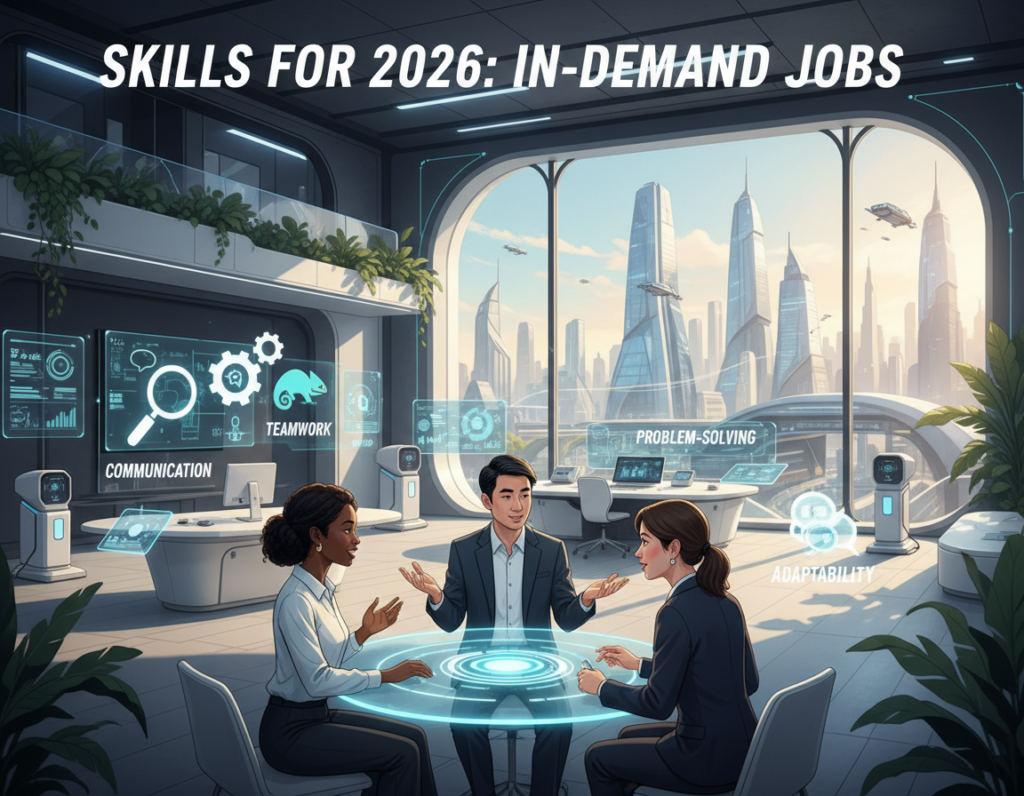
A simple framework: technical capability, domain knowledge, and durable human skills. Together these elements make a candidate adaptable as automation shifts which tasks are routine.
Technical baseline
Employers expect comfort with data tools and basic software development practices.
That means Python or SQL familiarity, understanding software delivery, grasping systems fundamentals, and applying security best practices.
Healthcare and care-focused skills
In clinical settings, strong patient communication, accurate documentation, care coordination, and compliance awareness set candidates apart.
These skills reduce errors and improve measurable outcomes in health teams.
Business and execution skills
Clear communication, planning, disciplined execution, and stakeholder management increase promotion potential across business areas.
Human skills that protect growth
Adaptability, critical thinking, and collaboration are the most durable protections against automation. They help workers move between tasks and teams.
“Candidates who can show the why behind a decision outperform those who only recite tools or steps.”
How to demonstrate ability: use portfolios, quantified outcomes, supervised hours, and short structured projects that reflect real processes.
| Skill area | Practical baseline | How to show it |
|---|---|---|
| Technical | Python/SQL, version control, security basics | Code samples, dashboards, labs |
| Healthcare | Patient communication, accurate records, coordination | Case logs, supervised clinical hours |
| Business | Planning, stakeholder updates, project metrics | Project summaries, before/after metrics |
Final point: focus on transferable skills. The more a set applies across teams and industries, the more resilient the career will be as information and process automation evolve.
Training, Education, and Experience Requirements by Role Type
Training choices shape how quickly someone moves from study to steady work in a chosen field.
This section maps practical education and time expectations so readers can pick realistic options.
Degree paths in technology, business, and advanced health
Technology and business tracks usually start with a bachelor’s degree. Typical examples include data science, software development, and market research.
Advanced health professions often require graduate study and clinical hours. Nurse practitioners, statisticians with clinical research, and veterinarians need master’s or professional degrees plus supervised experience.
Short programs, certificates, and apprenticeships
Many support and trade positions use shorter programs or apprenticeships. Examples: CDL in weeks, HVAC and wind technician programs in 6–12 months, welding in 4–12 months, and computer support certificates in 3–6 months.
Typical timelines and decision process
Compare time-to-hire against long-term growth. Degrees take years but unlock advanced scope. Short programs get people working quickly and often lead to employer-recognized credentials.
“Match training to the skills employers screen for, not just the name on a certificate.”
| Role type | Typical education | Time to hire | Experience expected |
|---|---|---|---|
| Technology (developer, analyst) | Bachelor’s + projects | 2–4 years (degree) or 3–6 months (certs) | Internships or portfolio |
| Advanced health (NP, vet) | Master’s / professional degree | 3–7 years | Clinical supervised hours |
| Trades & support (HVAC, CDL, welding) | Certificates / apprenticeships | Weeks to 12 months | Apprenticeship hours |
- Confirm entry requirements for the option chosen.
- Compare programs and plan hands-on practice.
- Build experience via internships, apprenticeships, or supervised work.
For guidance on aligning skills and titles over time, see why skills matter more than titles. Choosing the right mix of education, training, and experience will improve hiring outcomes and long-term career mobility.
Conclusion
The final takeaway condenses trends and training into a compact playbook for moving forward. ,
Align decisions around in-demand jobs by matching projected growth with a realistic plan to build skills, proof of work, and role-focused training.
Tech pathways reward strong data, software, security, and development foundations. Healthcare and trades favor reliable practice, compliance, and measurable outcomes.
Choose 2–3 targets, compare median salary, training time, and the education needed before committing.
Next steps: update a skills-based resume, assemble a small portfolio or documented samples, and pursue entry points that lead to advancement.
Employers hire candidates who show applied ability and continuous learning. Revisit skills and market signals regularly to keep opportunities open.